
The Journey
I Didn't Plan Any of This
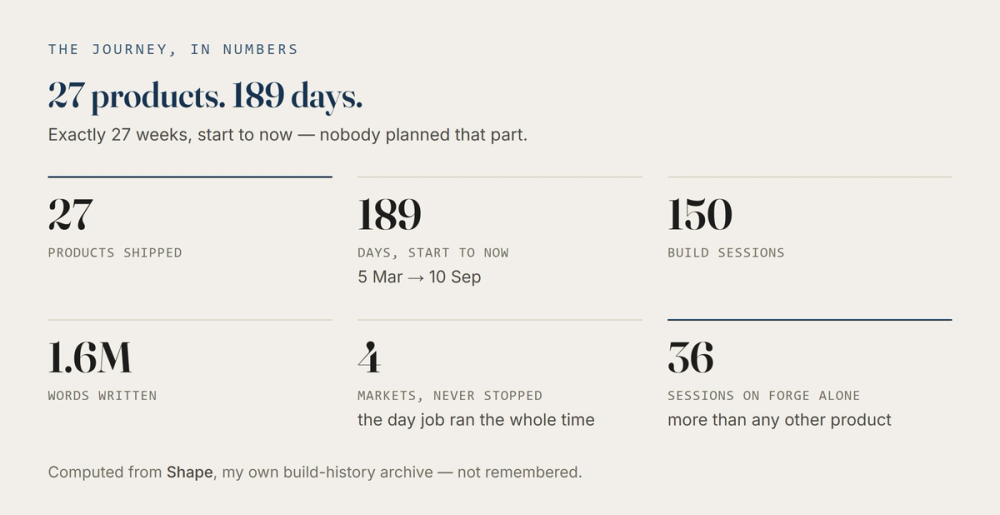
I didn't set out to build anything. I set out to stop reading about AI agents and actually try one — on a phone, in a hospital room, with nothing planned. Six months later there were twenty-seven of them.
If you'd told me in February this year that by September I'd have shipped twenty-seven pieces of software, trained a language model from scratch, and taught a security curriculum to my own engineers, I'd have laughed and gone back to whatever fire I was putting out that week.
I run delivery for a bank. My last hands-on coding was mainframe work, a long time ago. I don't say that to be modest — I mean it changed how this whole thing started.
Reading about AI for months taught me less, than one bad evening of trying it.
It started on a phone. In a hospital room, of all places. Fifth of March — nothing about that evening looked like a beginning at the time.
No laptop nearby, nothing planned. I'd been reading about AI agents for months the way most people do: articles, LinkedIn posts, the occasional demo video. I pulled down a self-hosted agent stack just to see if it did what people said it did.
It did. Badly, at first. But it did.
That one evening refused to stay contained. In the fortnight after, a couple more small things got built, mostly to solve my own problems. None of it had a name yet — it was just a habit that hadn't figured out it was a habit.
The first real product took six days — and it started as a distraction
I'd been prototyping an org chart tool in a chat conversation, the kind of back-and-forth you do when you're bored on a call. Somewhere around day twenty I looked at what I had and realized it actually worked. Drag-and-drop hierarchy editing, PDF export, the works. Six days from idea to something I'd use on a Monday.
That was the moment the hobby stopped being a hobby.
Everything I learned came from something being broken at 11pm
I won't pretend the next five months were smooth.
I built a testing platform to replace a Postman/ReadyAPI setup that was costing real money. Its "why does this return zero results" bug took three evenings to root-cause — it was reading a bare results array instead of the full response envelope. I put more into Forge than into anything else this year: thirty-six sessions. Of the twenty-seven, it's the one I did best.
The one I tend to undersell is the language model. It started where you're told not to start — a character-level model written from scratch, because I refused to call an API and call that understanding. A week later it was a fine-tuned 3B running entirely on my own machine, answering from 4,769 chunks of my own work, showing its sources beside every answer, and refusing outright when the evidence wasn't there.
I also built the exam it had to sit before I'd trust it. My first serious model failed it. I trained another, scored it 20 out of 30 against the old one's 16, and only then let it through.
The hardest ones were the two I had no business starting
The hardest products weren't the ones with the most moving parts. They were the two with no foundation under them at all: that model, and the Android app — a native app with genuinely zero prior mobile experience, which in hindsight was a slightly unhinged decision to make on a Tuesday. Everything else extended a skill I already half-had.
I remember genuinely asking myself "is this even mine to attempt" before starting either one. Both got done.
It wasn't talent and it wasn't free time — it was a six-inch screen
I had a full delivery job carrying four markets the entire time. What made it possible was the constraint: building on a phone forces smaller scope and tighter asks, because you physically can't sprawl on six inches. It never needed a desk either — it carried on in the car, by the sea, in whatever twenty minutes were going spare. Somewhere in there the asking itself became the hobby: I still enjoy getting a request down to the smallest version that still works, enough that I built a tool for it.
Six months in, I asked my own build history what changed
It didn't flatter me. Thirty-eight times I sent a fix back and told it to find the real cause instead of patching the symptom. Most of what I learned this year wasn't about AI — it was about catching it.
What you'd actually get out of this
I'm not telling you to build twenty-seven things in your spare time. I'm not sure that's a healthy template for anyone, myself included some weeks. But if you take anything from six months of it:
🧱 Start smaller than feels serious. Mine started on a phone, in a gap I didn't choose, with no plan attached.
🔨 Go until it breaks. The uncomfortable part — debugging, failing, retracing — is the part that teaches.
🧭 The project that scares you is the one that moves you. No foundation isn't a reason to stop.
📊 Track it. Six months of change doesn't feel like anything day to day. The history showed me what I couldn't feel.
If you want a governance framework, an opinion on whether your team should use a given AI tool, or just want to know whether the thing you read about actually works — I've usually already broken it myself, on a Tuesday night, trying to make it behave.
Starting from a phone in a hospital room in March, with no coding background beyond old mainframe work, this person shipped twenty-seven pieces of software in six months while running full-time bank delivery work across four markets. The output included a testing platform that replaced costly commercial tools, a fine-tuned language model running locally on 4,769 chunks of personal work with source citations, and a native Android app built with zero prior mobile experience.
None of it was planned or scheduled — it happened in spare twenty-minute gaps, driven by the constraint of a small screen forcing small scope. The lesson: start smaller than feels serious, push through the breaking points, and track progress, because real change is invisible day to day.
Drafted by Claude · reviewed by JP ·
The writer works in banking and hadn't coded in years, aside from very old mainframe work. One evening in March, with just a phone and no plan, they tried out a self-hosted AI agent stack — software that lets an AI act on tasks somewhat independently. It worked, badly at first, but well enough to keep going. Over the next six months, without ever meaning to, they built twenty-seven pieces of software, all on a phone in spare moments.
One project was a language model — the kind of AI behind tools like ChatGPT — built entirely from scratch instead of just using someone else's. It ended up running on their own computer, answering questions using 4,769 chunks of their own writing, showing where each answer came from, and refusing to answer when it didn't have evidence. They even built a test to grade it before trusting it.
They also built an Android phone app despite never having made one before, and a testing tool that replaced other paid software.
None of this came from talent or free time — it came from small steps, tolerating things breaking, tackling scary projects anyway, and tracking progress, since change like this doesn't feel noticeable day to day.
Drafted by Claude · reviewed by JP ·